
THE $40M CLICK
When Mark Cuban Bought a Gulfstream V Online
In October 1999, only a few months after selling Broadcast.com to Yahoo!, Mark Cuban agreed to buy a new Gulfstream V for around US$40 million. The transaction, conducted largely through email, was recognised by Guinness World Records as the largest single e-commerce purchase of its time. The aircraft made headlines, but the more enduring story is how one purchase captured a moment when business was beginning to place real confidence in the internet—and when private aviation was quietly becoming part of a changing corporate landscape.

Before the headline
By the autumn of 1999, Mark Cuban had reached a point familiar to many successful entrepreneurs. Business was expanding faster than geography could comfortably accommodate it. Meetings that had once involved a short domestic flight or a drive across Texas were increasingly taking place on opposite sides of the United States and, before long, overseas. Success had opened doors, but it had also made time a more precious commodity.
Looking back, it’s tempting to see the purchase of a private jet as an inevitable consequence of extraordinary wealth. In Cuban’s case, the story is slightly more interesting than that. Long before Broadcast.com made him one of the most recognisable figures of the dot-com era, he had developed a habit of investing in things that made work easier rather than simply more luxurious.
After selling his first major business, MicroSolutions, to CompuServe in 1990, Cuban bought an American Airlines lifetime first-class pass. He has since explained that he spent so much time travelling that it simply made practical sense. The story is often retold because of its novelty, but it also offers an early glimpse into how he thought. The purchase wasn’t really about flying first class. It was about removing one small piece of friction from a working life that increasingly revolved around being somewhere else tomorrow.
That practical mindset appeared repeatedly throughout his career. Cuban has often described himself as someone more interested in solving problems than chasing technology for its own sake. Whether it was software, broadcasting or aviation, the attraction tended to lie in making something quicker, simpler or more efficient. Seen through that lens, the Gulfstream V begins to feel less like an extravagant reward for success and more like the next logical step.
A basketball problem
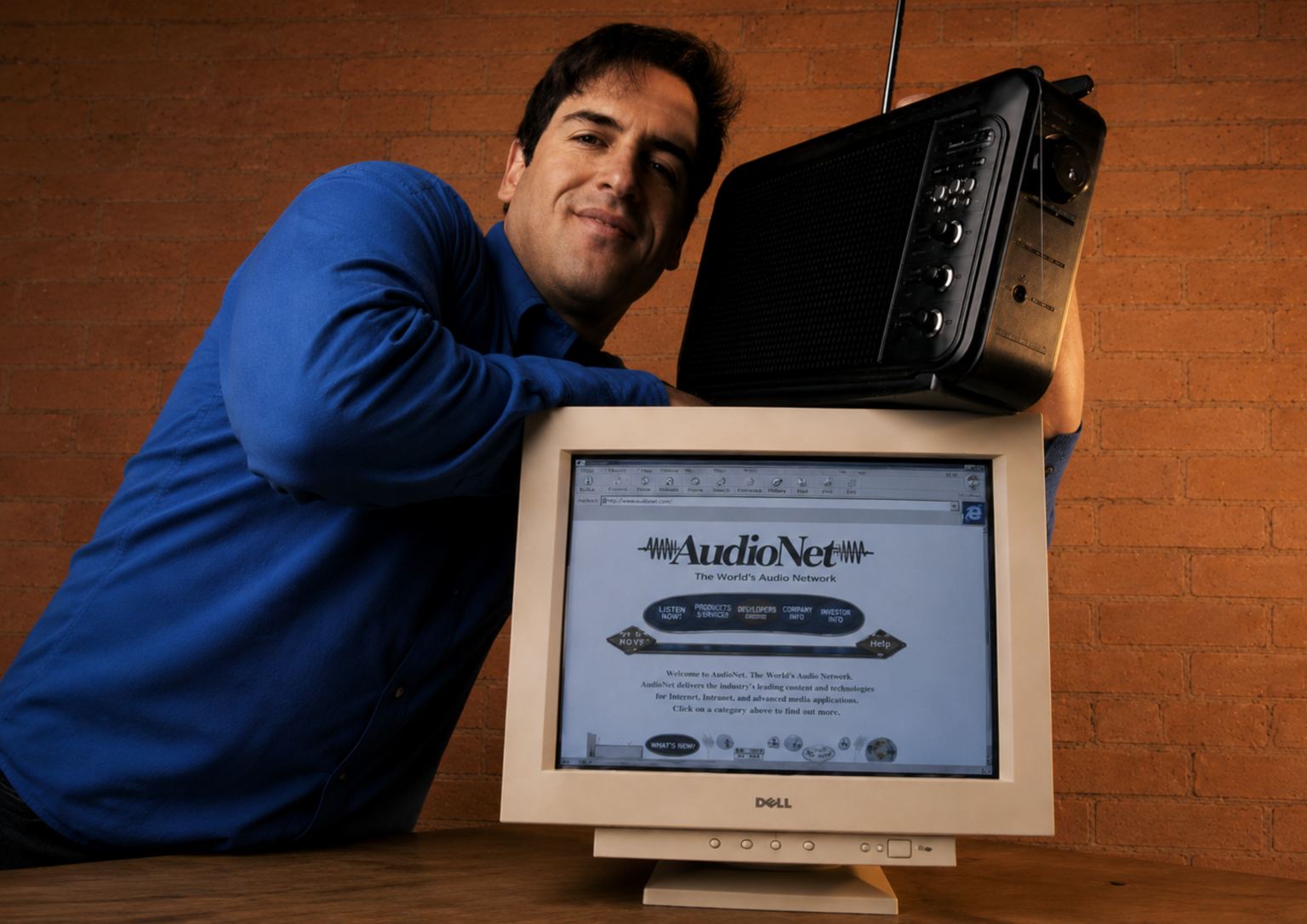
Like many successful businesses, Broadcast.com began by solving a surprisingly ordinary problem.
While living in Dallas, Cuban wanted to listen to Indiana Hoosiers basketball games from hundreds of miles away. Together with his friend and business partner Todd Wagner, he became involved with AudioNet, a young company experimenting with streaming audio over the internet. Today that sounds entirely unremarkable. In the mid-1990s, it was anything but.
Internet connections were slow, streaming technology was still in its infancy and relatively few people imagined the web would become a place to watch live events. AudioNet, which later became Broadcast.com, wasn’t trying to reinvent the media industry overnight. It was simply making broadcasts available to people who otherwise couldn’t access them. As the business grew, that same idea expanded into radio stations, television channels, sporting events, corporate presentations and political conventions. The technology evolved quickly, but the underlying proposition remained remarkably straightforward: reduce the distance between people and the content they wanted.
It is easy to forget how unfamiliar the internet still felt during those years. Google had only recently been founded, Amazon was best known as an online bookshop and many consumers remained hesitant about entering payment details into a website. Broadcast.com emerged during a period when businesses were beginning to explore what the internet might become, rather than taking its possibilities for granted.
That timing proved significant. The company went public in 1998 and, less than a year later, Yahoo! announced it would acquire Broadcast.com in a stock deal valued at around US$5.7 billion. The acquisition closed in July 1999, turning Cuban into one of the defining entrepreneurs of the internet boom almost overnight.
The deal transformed his finances, but it also changed the rhythm of his working life. Opportunities became national, then increasingly international. Travelling stopped being an occasional requirement and became an everyday part of doing business.
Doing business differently
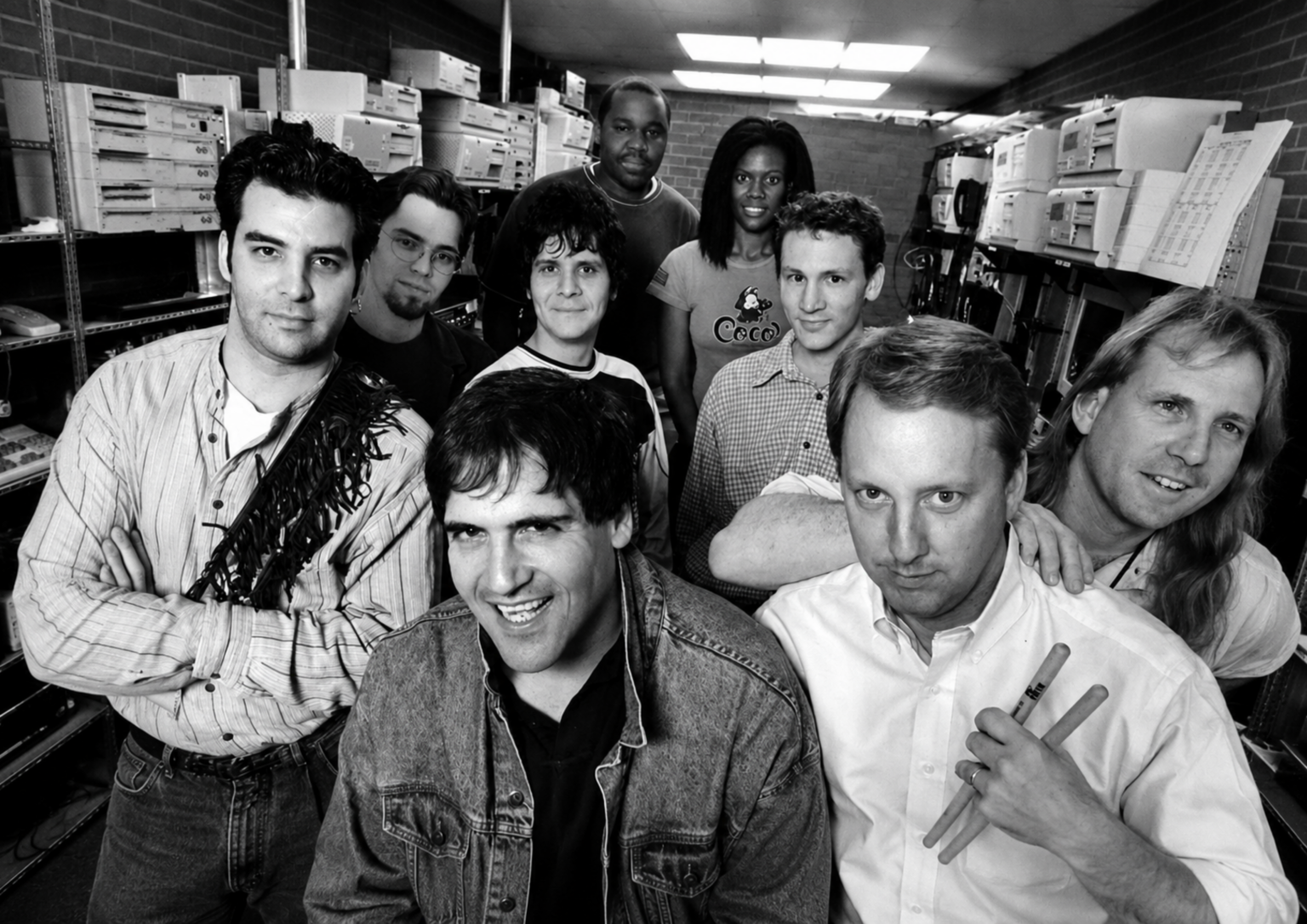
The internet has often been described as revolutionary, but revolutions rarely feel that dramatic while they’re happening. More often, change arrives gradually. One process becomes a little quicker, one conversation becomes a little easier and, before long, people realise they’re working in a noticeably different way.
The late 1990s marked one of those periods. Businesses were becoming increasingly comfortable using email for day-to-day communication, researching products online and completing transactions electronically that only a few years earlier would almost certainly have involved printed documents, fax machines or lengthy face-to-face meetings. The technology itself was still evolving, but confidence in using it was evolving too.
Cuban was very much part of that shift. In later interviews discussing the Gulfstream purchase, he explained that email had already become his preferred way of conducting much of his business. Against that backdrop, researching an aircraft online and communicating with Gulfstream electronically was less a publicity stunt than an extension of habits he had already developed.
That distinction matters because it helps explain why the purchase has remained so memorable. The story is often reduced to a billionaire buying a $40 million aircraft over the internet, yet the transaction makes far more sense when viewed in the context of the wider business environment. Companies were beginning to discover that digital communication could handle increasingly important decisions, provided the relationships and expertise behind those decisions remained strong.
By the end of 1999, Cuban had reached another practical decision. Commercial airlines had served him well throughout the earlier stages of his career, but the demands of running an increasingly international business had changed. If the internet had helped remove the constraints of geography for Broadcast.com, private aviation offered the opportunity to do something similar for the person running it.
The next question wasn’t whether to buy an aircraft.
It was which aircraft best reflected that new reality.
Why the Gulfstream V?

Introduced in 1997, the Gulfstream V arrived at an interesting moment in both aviation and business. It was among the first purpose-built business aircraft capable of connecting many of the world’s major financial centres non-stop, offering a published range of around 6,500 nautical miles and quickly establishing itself as Gulfstream’s flagship. Those specifications certainly attracted attention, but they don’t entirely explain why the aircraft became so closely associated with a new generation of business leaders.
Corporate aviation had traditionally been dominated by established multinational manufacturers, banks and industrial groups whose international operations had evolved over decades. By the late 1990s, technology companies were expanding internationally at a much earlier stage in their lives. Their founders were moving between investors, customers and offices at a pace that previous generations of executives had rarely experienced. Aircraft like the Gulfstream V reflected that changing pattern of business, offering flexibility that scheduled airlines simply couldn’t provide.
For Cuban, the decision appears to have been driven by exactly those practical considerations. He has since described the aircraft as one of the smartest purchases he ever made, not because of its appearance or prestige, but because of the time it saved him. It’s a revealing observation. Throughout his career, the common thread had been removing unnecessary obstacles, whether that meant finding a better way to stream live broadcasts, buying a lifetime airline pass or investing in an aircraft that allowed him to dictate his own schedule rather than someone else’s.
That perspective also helps explain why the Gulfstream V has remained such an admired aircraft long after newer models have arrived. Later generations would fly further, burn less fuel and introduce more advanced technology, but the GV represented a step change in what long-range business aviation could realistically achieve. It wasn’t simply an impressive aeroplane. It arrived at precisely the moment many businesses were beginning to think differently about distance.
Trusting the process
The popular version of the story often suggests that Cuban bought a private jet online in much the same way someone might order a laptop today. The reality was naturally more measured, although no less interesting.
After researching the Gulfstream V through the manufacturer’s website, Cuban arranged for his pilot to evaluate the aircraft. Rather than attending the demonstration himself, he relied on someone whose judgement he trusted. Recalling the experience years later, he explained that his pilot returned enthusiastic about the aircraft. Cuban then confirmed the purchase by email, received the banking instructions and wired the funds. As he later put it, “I use e-mail for nearly all my business correspondence.”
That final remark may be the most revealing part of the entire story.
The transaction was unusual because of its scale, not because it ignored established business practices. There was still expert advice, technical evaluation and direct communication between buyer and manufacturer. What had changed was the medium through which much of that process took place. Email had become sufficiently trusted to support a transaction that only a few years earlier would almost certainly have involved considerably more travel, paperwork and face-to-face meetings.
Guinness World Records recognised the purchase as the largest single e-commerce transaction of its time, and that distinction has understandably dominated most retellings. Yet the record itself almost feels secondary. More interesting is what the purchase quietly revealed about changing business habits. By the end of the 1990s, the internet was no longer simply a place to browse information. Increasingly, it had become part of how major commercial decisions were researched, discussed and completed.
Private aviation would follow a similar path over the years that followed. Relationships remained central to the industry, but much of the surrounding process evolved. Aircraft could be researched online, contracts signed electronically and flights monitored from a mobile phone. The human element never disappeared; technology simply made many of the practical steps more efficient.
Today, aircraft from the same Gulfstream generation still arrive in all around the world every day. They continue to perform much the same role they were designed for a quarter of a century ago, quietly connecting people whose businesses operate across multiple countries and time zones.
LOOKING BACK

The $40 million figure is what ensured the story would be remembered. It was an irresistible headline in 1999 and remains an eye-catching one today. Yet with the benefit of hindsight, the amount of money involved feels less significant than the way the purchase was conducted.
Businesses now exchange contracts electronically, move substantial sums digitally and make complex purchasing decisions without necessarily meeting in person. None of that feels especially novel anymore. Like so many useful technologies, digital communication gradually stopped drawing attention to itself and simply became part of everyday working life.
Perhaps that is why the story still resonates more than twenty-five years later. It isn’t really about a billionaire buying a private jet, nor is it solely about the internet. It captures a moment when two industries—technology and business aviation—were both responding to the same idea: that time had become increasingly valuable, distance increasingly irrelevant and the tools available to bridge that distance increasingly sophisticated.
The Gulfstream V remains an elegant aircraft and an important chapter in business aviation. Mark Cuban’s purchase remains an unusual footnote in internet history. Together, they tell a story that feels surprisingly contemporary. Not because it predicted the future with perfect accuracy, but because it reminds us how quickly remarkable ideas become routine once they prove useful.
At a Glance
Aircraft: Gulfstream V
Introduced: 1997
Buyer: Mark Cuban
Purchase date: October 1999
Approximate value: US$40 million
Recognition: Largest single e-commerce transaction at the time (Guinness World Records)
“Flying out after a late-night game to be at a meeting the next morning. Leaving a meeting to get home in time for my daughter’s first daddy-daughter dance. It’s part of my life that I can’t be without.”
“There are too many examples to count of how the airplane has helped me,”
“It means I have more hours in my day to spend with friends and family. It means I can get more work done. It means I can travel comfortably with my family. It’s a life- and game-changer.”
— Mark Cuban

Sources include: Andy Scott / The Dallas Morning News / MCT / ZUMA Press, Christopher Willard / ABC via Getty Images, JetPhotos, Mark Graham, Mark Perlstein / Getty Images, PlaneLogger, Ron T. Ennis / Fort Worth Star-Telegram / MCT / Getty Images.

At a Glance
Aircraft: Gulfstream V
Introduced: 1997
Buyer: Mark Cuban
Purchase date: October 1999
Approximate value: US$40 million
Recognition: Largest single e-commerce transaction at the time (Guinness World Records)
“Flying out after a late-night game to be at a meeting the next morning. Leaving a meeting to get home in time for my daughter’s first daddy-daughter dance. It’s part of my life that I can’t be without.”
“There are too many examples to count of how the airplane has helped me,”
“It means I have more hours in my day to spend with friends and family. It means I can get more work done. It means I can travel comfortably with my family. It’s a life- and game-changer.”
— Mark Cuban